
By Fredrick Mugira
This collection documents the daily realities of water gathering across rural Uganda. Beyond the reach of the piped water networks, communities depend on a fragile network of natural seeps, aging concrete spring boxes, and unprotected surface pools. These visual artefacts explore the intersection of physical labor, water quality, and infrastructure decay.
Balancing for Survival
Location and Context: Sheema District, Open Surface Spring.
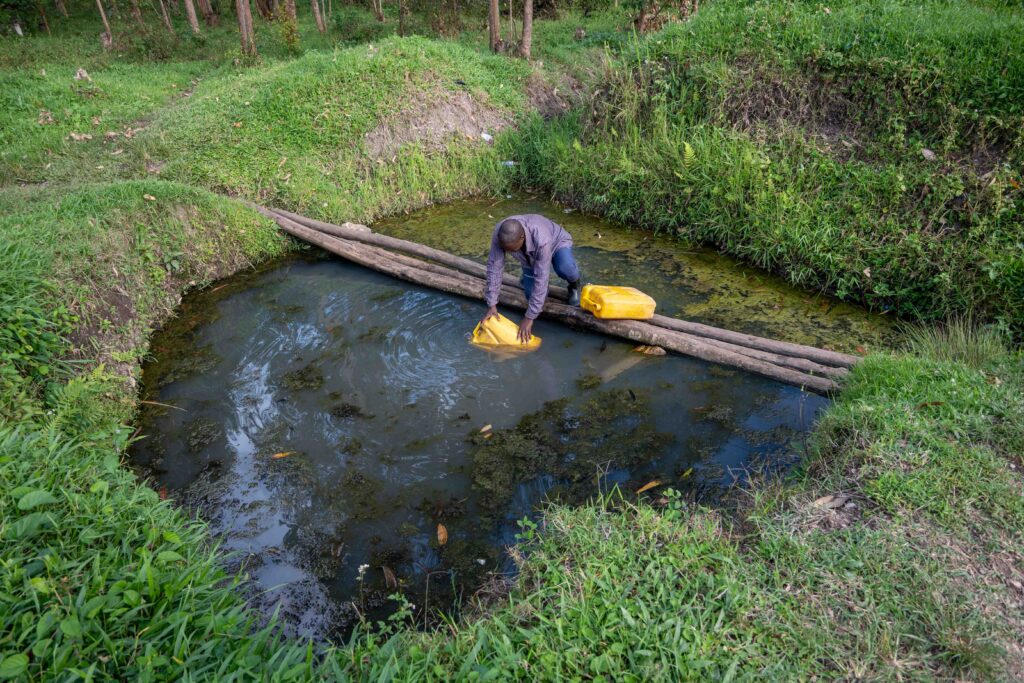
In many rural areas of Uganda, people still rely on unprotected open pits as their main source of water for daily use. In this photograph, a youth balancing on old wooden logs above a still pool covered in algae, dips a jerrycan to collect water. These open water sources are easily contaminated by runoff, waste from animals, and chemicals from nearby farms, which puts people at risk of getting waterborne diseases again and again.
Beneath the Hatch
Location and Context: Isingiro District, Community Well
An elder community member inspects a narrow, ground-level access hatch leading to an underground water collection chamber. Rural water points built during historical infrastructure drives lack routine monitoring or maintenance by the local government authorities. As a result, community elders and local committees shoulder the sole responsibility of assessing and managing the safety of their primary water supply.

Corrosion and Contamination
Location and Context: Isingiro District, Conduit Pipe
Inside an aging water storage tank, a corroded iron discharge pipe empties into standing water littered with agricultural residues and plastic debris. Oxidation, pipe degradation, and unsealed access chambers create severe secondary contamination risks. This means that water gets contaminated at the source, even before it reaches the jerrycan.

The Natural Seep
Location and Context: Rwampara District, Rock Outcrop Spring
Barefoot on wet rock, a young man fills a jerrycan from a natural trickling seep in a rocky hillside. Where boreholes break down, or piped taps fail, communities revert to raw spring trickles. During dry spells, low discharge rates turn fetching water into an exhaustive multi-hour task. This forces collectors, mostly youths and women, to wait for hours for individual jerrycans to fill drop by drop.

Measure by Measure
Location and Context: Rwampara district, Scoop Point
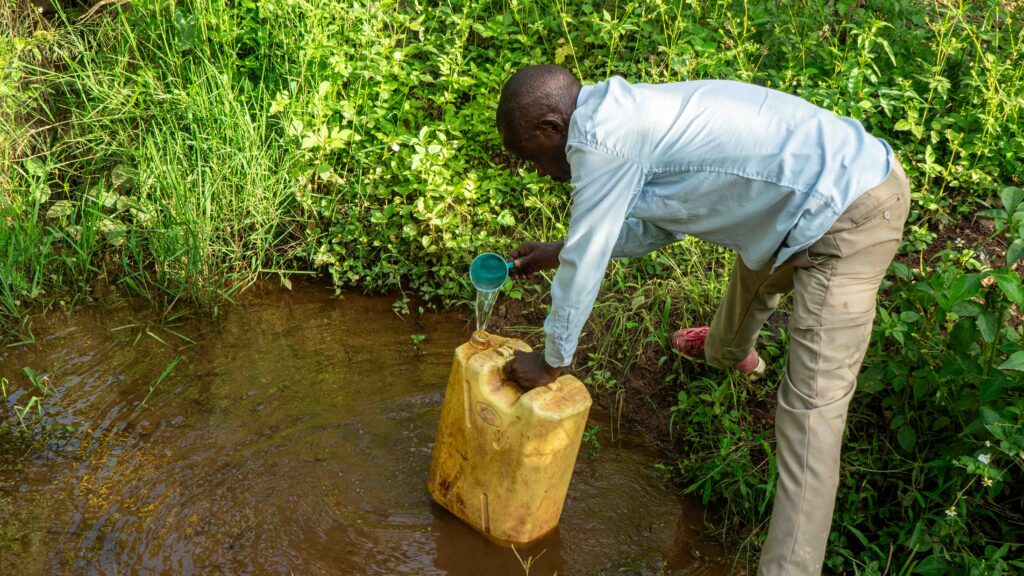
When water levels drop too low to submerge a standard 20-liter container, collection becomes a slow, precise effort. A collector uses a small plastic cup to skim water off the surface into a narrow jerrycan opening, exercising care not to disturb the muddy sediment at the bottom of the pool.
What Remains in the Glass
Location and Context: Sheema District, Water Quality Sampling
A sample of water scooped directly from a rural shallow well reveals high turbidity, suspended organic particles, and active algal growth. In the absence of household filtration systems, chlorination tablets, or fuel to boil water, households consume water of this condition daily. This leads to several water borne diseases across rural communities in Uganda.

Compromised Protection
Location and Context: Rwampara district, Protected Spring Box Channel
A child stands inside a concrete spring intake channel, filling jerrycans lined up against a retaining wall. While protected springs are engineered to isolate clean groundwater from overland contamination, poor drainage design, localized flooding, and standing mud around the collection platform usually compromise the sanitary barrier.
